
How to choose the right food for your dog without getting lost in the marketing
The label criteria worth checking, and the ones that are mostly marketing.
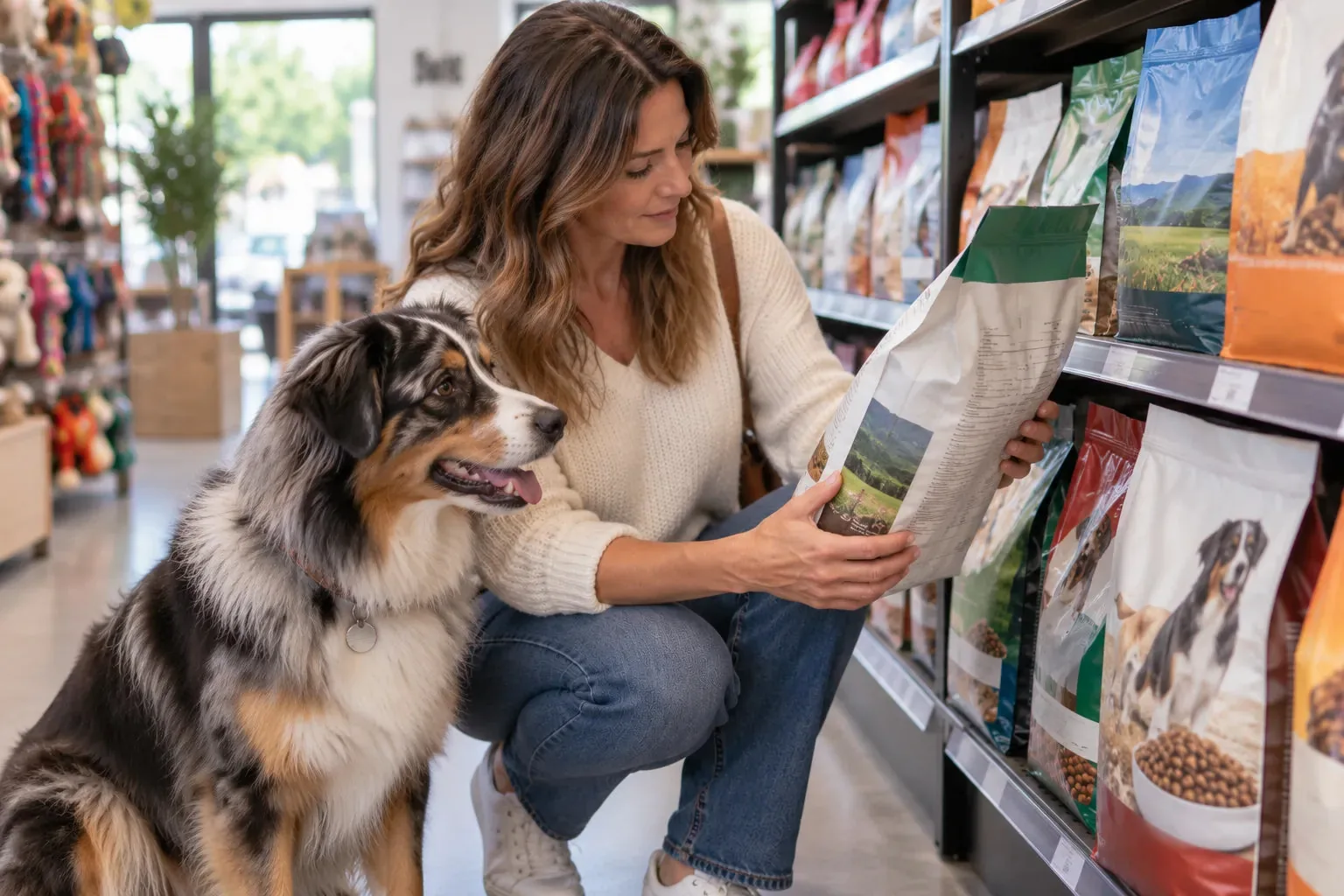
In the dog food aisle, there's no shortage of claims: meat-rich, natural, grain-free, superfoods, carefully selected ingredients…
At first glance, they seem to help you spot a quality food. Yet they're rarely the best criteria for making a choice.
Even the ingredient list can be misleading when you try to compare two foods. Chicken listed first, a few blueberries or a long list of appetizing-sounding ingredients don't tell you whether a food is well formulated.
So what should you look at?
A few much less visible pieces of information on the package are more useful for sorting things out. The life stage the food is intended for, the “complete and balanced” statement and the manufacturer's practices are among them.
Here's how to spot what really matters and put marketing claims in their proper place.
Start with your dog, not the package
Before comparing ingredients or the promises on the package, start by looking at who the food is intended for.
For a first sort, check:
- its age and life stage;
- its size;
- its activity level;
- its body condition.
So a very well-formulated food isn't automatically the right choice for every dog.
If your dog has a health problem or needs a special diet, the choice of food should instead be discussed with your veterinarian.
For a healthy dog, the next step is to set aside the front of the bag and look for what will actually help you compare options.
Turn the bag over: that's where the useful information is
The front of the bag is designed to catch your attention. To compare two foods, the most useful information is on the back or sides of the package instead.

Look for the “complete and balanced” statement
A food meant to be your dog's main diet should state that it is complete and balanced for a specific life stage.
This statement means the food meets the nutritional requirements set for the stated life stage. In the United States, the label may specify that the food meets the nutrient profiles established by AAFCO or that it has undergone feeding trials following its procedures.
This small statement tells you more than a word like premium or a photo of fresh meat on the front of the bag.
💡 Good to know
In Canada, a food doesn't necessarily have to display a statement referring to AAFCO. The Canadian guide to labelling dog and cat food recognizes different programs that can be used to establish a food's nutritional information.
So the absence of the name AAFCO isn't enough to rule out a food. Instead, check whether the label states that the food is complete and balanced for the life stage you need and, if necessary, which standards or nutritional program the manufacturer refers to.
Check the life stage
Once you've found the complete and balanced statement, also check which life stage the food was formulated for.
You may see an indication for:
- growth;
- adult maintenance;
- gestation and lactation;
- all life stages.
A food intended for all life stages must meet the requirements for growth, among others. So this statement doesn't simply mean it's “better” or more suitable for every dog.
Find the calories and feeding guidelines
Two foods that seem comparable may not have the same calorie content for an equivalent portion.
The feeding guidelines on the package are a starting point. They don't take every dog's particular needs into account, especially its activity and body condition.
Don't choose a food based only on its ingredient list
The ingredient list is worth reading, but it can't on its own tell you whether a food is good quality.
Ingredients are listed in descending order by weight at the time of manufacture. This way of ranking them can give a misleading impression when you compare ingredients that don't contain the same amount of water.
The first ingredient doesn't determine quality
Fresh chicken contains a lot of water. Its weight can therefore earn it a high spot in the ingredient list. A dehydrated ingredient contains much less water and may appear further down, even though it's more concentrated.
So seeing “chicken” first doesn't let you conclude that a food contains more protein or is better quality than another.
Highlighted ingredients can be misleading
Blueberries, spinach, pumpkin, cranberries… These ingredients easily catch the eye because they evoke foods we associate with healthy eating.
The list doesn't tell you how much is actually present, though, or how important these ingredients are to the food's nutritional balance.
So a few appealing ingredients on the package shouldn't weigh more in your decision than the food's formulation and the information provided by the manufacturer.
Words that catch the eye… but shouldn't decide for you
Packages use words that quickly suggest quality. Some have a precise definition, others much less so. Either way, they shouldn't replace the criteria we've just covered.
| You see on the bag… | What you should know |
|---|---|
| Premium | This term doesn't impose higher nutritional requirements. |
| Natural | This term mainly concerns the origin and processing of the ingredients, not the food's nutritional quality. |
| Meat-rich | Meat featured on the package doesn't guarantee a better-balanced food. |
| Superfoods | Their presence reveals neither their quantity nor their importance in the formulation. |
| Grain-free | For a healthy dog, the absence of grains isn't a guarantee of better quality. |
| Human grade | This statement concerns the ingredients and manufacturing conditions, not the food's nutritional superiority. |
“Natural” doesn't necessarily mean “better”
Under AAFCO's definition, an ingredient can undergo various processes (cooking, extraction, purification or fermentation, for example) and still be considered natural. AAFCO also specifies that this term is not an indication of safety.
In other words, natural tells us about certain characteristics of the ingredients and their processing. It doesn't tell us whether the food is better formulated for your dog.
The right reflex: when a word on the front of the bag seems convincing, ask yourself what it actually tells you. If it tells you nothing about the food's formulation, its manufacturing or its suitability for your dog, put it in perspective.
Look into the manufacturer too
A food's quality isn't judged only by its label. How it's formulated, made and quality-checked matters too.
To go beyond the claims on the package, look for a few concrete facts about the manufacturer.
4 useful questions to check
1. Who formulates the recipes?
A company should be able to explain who develops its foods and what qualifications that person or team has in animal nutrition.
2. What quality controls are carried out?
Look for specific information rather than a simple statement like rigorous quality control. The company should be able to explain how it checks its ingredients and finished products.
3. Can the company answer specific questions about its foods?
A manufacturer should be able to provide nutritional information that goes beyond what appears on the package.
4. Does it do research on its products?
WSAVA also suggests checking whether the company carries out nutritional studies or research on its foods and whether that work is published in scientific journals.
Where can you find this information?
Start with the manufacturer's website. Look for pages on nutrition, formulation, manufacturing or quality control.
If the answers remain vague or can't be found, contact the company directly.
A brand doesn't need the nicest website or the most convincing bag. What matters more is its ability to explain who formulates its foods, how they're made and how their quality is checked.
Before choosing your next food
Faced with several bags, it's not always easy to remember what deserves your attention.
To help you compare your options, we've prepared a comparison grid (in French). You can note up to three foods and compare them using the criteria explained in this article.
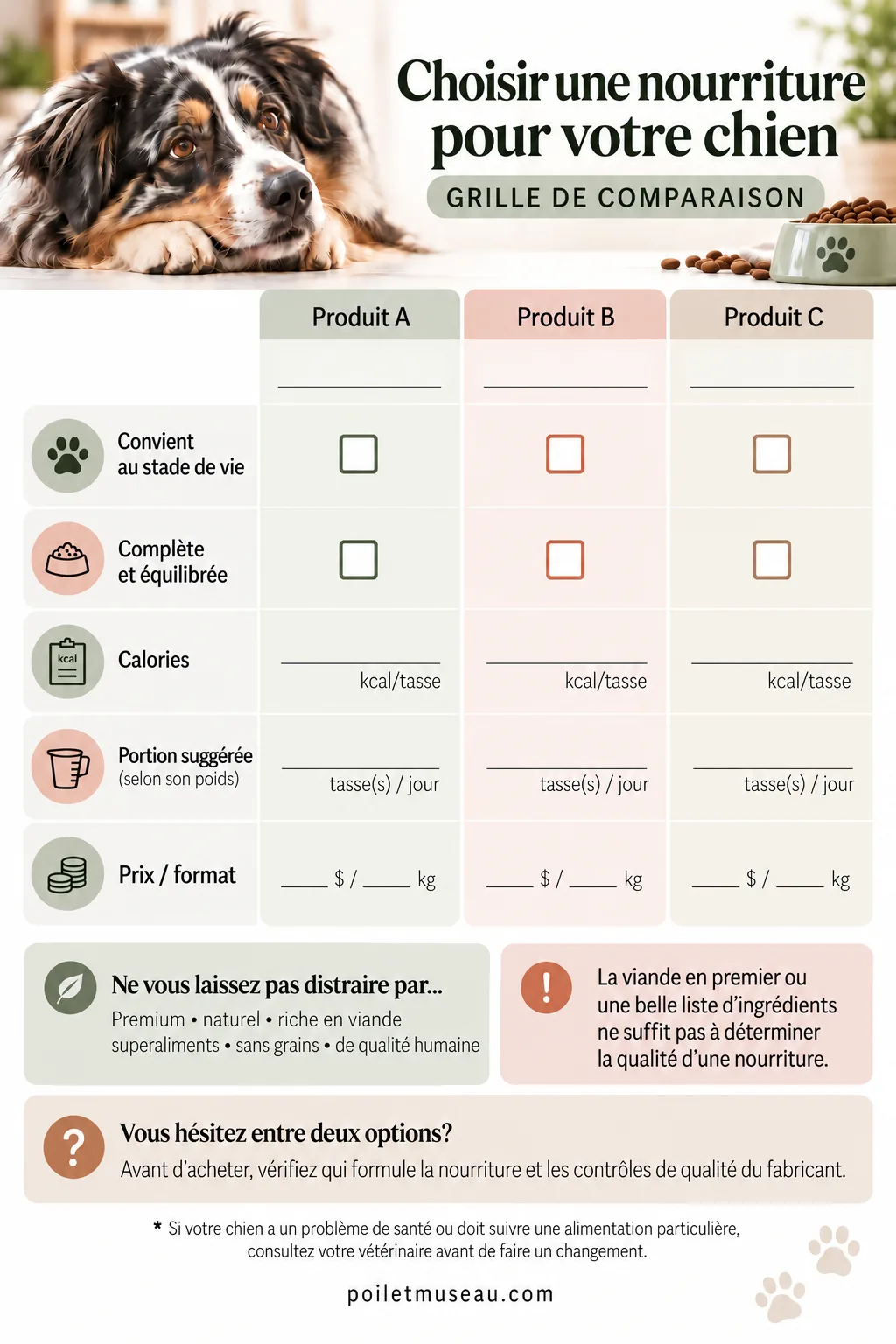
📥 Download the comparison grid
To store kibble after opening the bag
An airtight container helps protect it from moisture and makes storage easier.
👉 See the airtight container
A nice ingredient list or convincing packaging may catch your attention. Before choosing, check instead whether the food suits your dog, what its label tells you and what information the manufacturer can provide.
Sources
This article is based in particular on the recommendations of the World Small Animal Veterinary Association (WSAVA) on choosing a food and evaluating the manufacturer, AAFCO resources on labelling and the claims used on pet foods, the Competition Bureau of Canada for Canadian labelling guidelines, and work from Tufts University's Cummings School of Veterinary Medicine on interpreting ingredient lists.