Why does your dog tilt its head when you talk to it?
Attention, familiar words, hearing, vision: what research tells us.
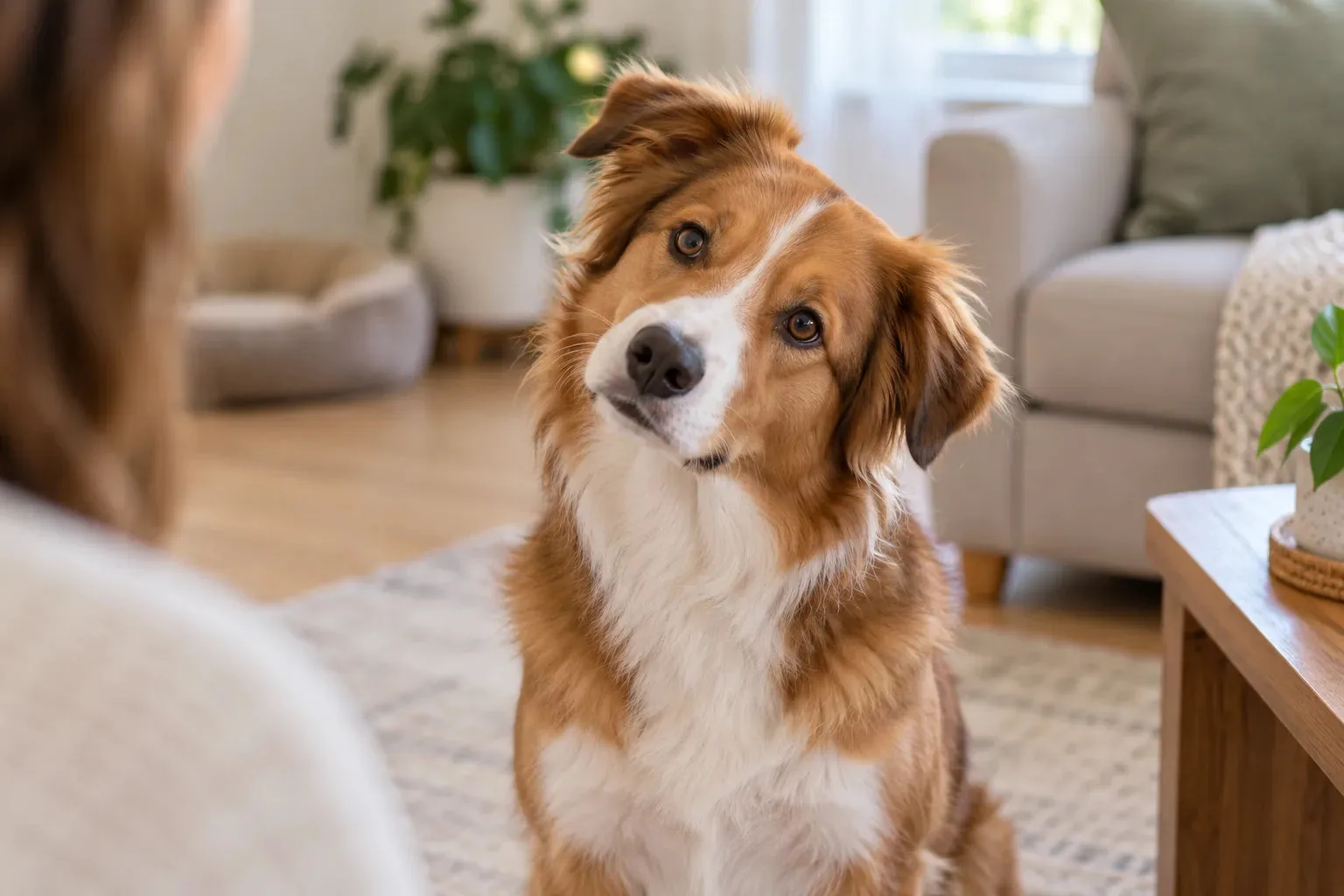
You're talking to your dog and, all of a sudden, its head tilts slightly to the side.
You repeat a word and there it goes again.
As endearing as this little movement is, it raises a question: why do dogs tilt their heads when we talk to them?
Are they trying to hear better? To understand what you're saying? Are they reacting to a word they recognize?
Researchers have looked into this behaviour and their observations offer some answers. But not every head tilt means the same thing: when a dog suddenly keeps its head tilted for no apparent reason, it may need closer attention.
Let's look at what we know today about this behaviour and what it may reveal when your dog is listening to you.
In this article
- What we know about this behaviour
- Does your dog react to words it knows?
- When a word becomes familiar to your dog
- Explanations linked to hearing and vision
- Not all dogs tilt their heads the same way
- When a tilted head deserves more attention
- The influence of your reaction
- Frequently asked questions about head tilting in dogs
What we know about this behaviour
Researchers don't yet know exactly why dogs make this movement when we talk to them.
Different explanations have been proposed. The dog may change the position of its head to better locate a sound or to get a better look at the face of the person in front of it.
Recent research suggests the head tilt may also be linked to the attention the dog pays to what it hears.
Does your dog react to words it knows?
A study published in Animal Cognition looked at 40 dogs while their person asked them to fetch a toy by saying its name.
Among them, seven dogs had learned to recognize the names of different toys. These dogs tilted their heads in 43% of trials, compared with only 2% for the other dogs.
Another study, published in 2025, observed 103 purebred or mixed-breed dogs in different communication situations. Head tilts were more frequent when the dogs heard familiar words accompanied by more social cues, such as eye contact and the person addressing them directly.
These results don't mean your dog understands every word. They do suggest, however, that this movement may appear when it pays particular attention to information it recognizes or that matters to it.
When a word becomes familiar to your dog
Does your dog suddenly seem more attentive when you say walk, toy or treat? It's not necessarily the word itself that triggers a head tilt. Over time, it can learn to associate words with actions, objects or familiar situations.
For example, it may react when it hears:
- the name of a toy;
- a word associated with an activity, like a walk;
- a cue it knows;
- a word linked to mealtime or a treat;
- the name of a person or another animal in the home.
Research has even shown that dogs able to learn the names of objects can memorize several of them. This ability remains unusual, though: after three months of training, only one of the 34 dogs starting this learning passed the tests. The six dogs already known for this skill all passed.
In that same research, people repeated the toy's name during short play sessions and rewarded the dog with praise, continued play or food.
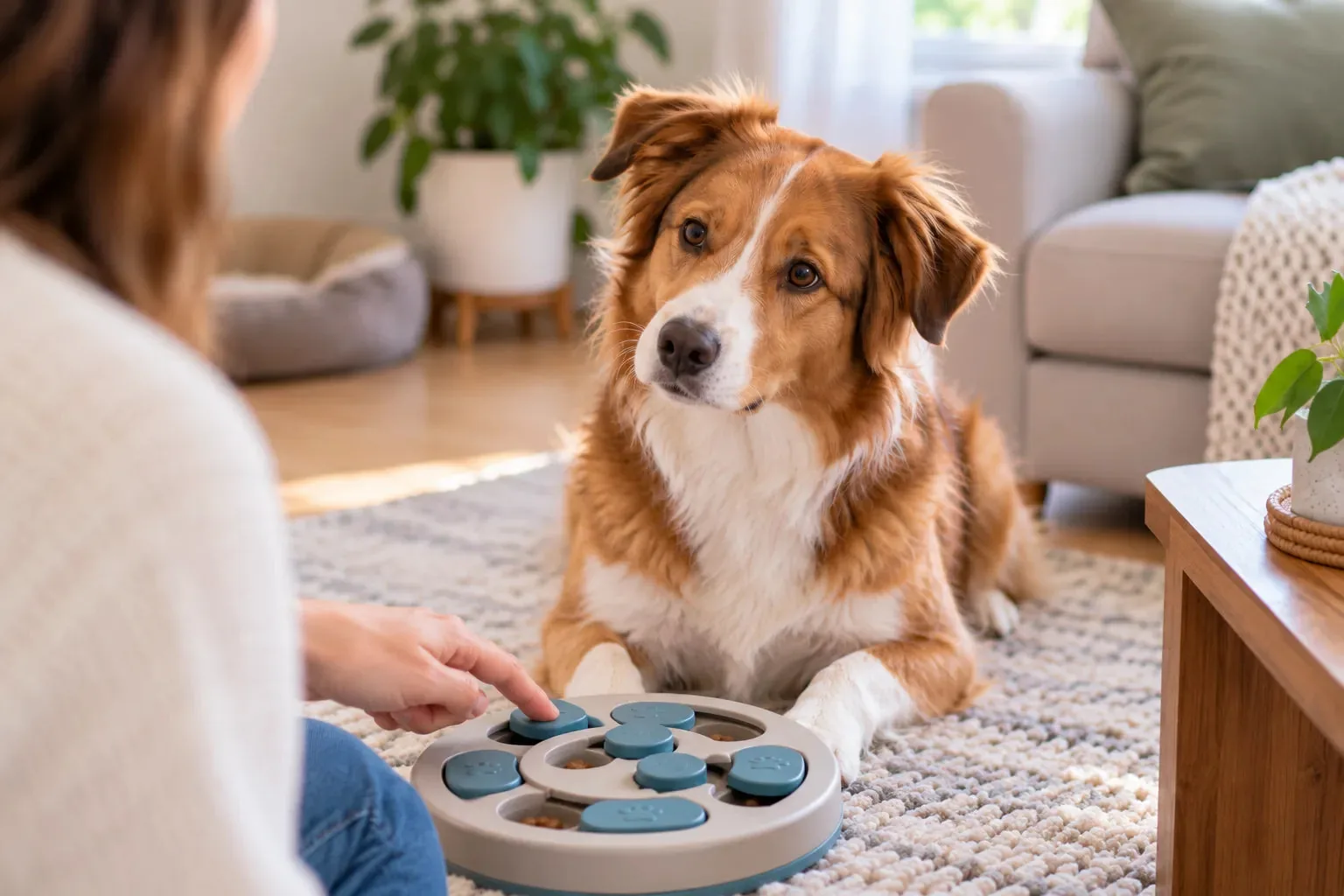
You can try the experiment at home: choose a toy and always use the same word for it when you play with your dog. When it shows interest in that toy, you can praise it, keep playing or offer a small treat if it's food-motivated.
If it doesn't learn to recognize the word or never tilts its head, the exercise can simply become a fun way to observe how it responds to the words you use.
Explanations linked to hearing and vision
Reacting to familiar words isn't the only lead being studied to explain the head tilt. Hearing and vision are also among the hypotheses.
Locating sounds
Dogs hear very well, but they still need to work out where a sound is coming from. The shape and position of their ears can change how they perceive it.
Tilting or turning the head could therefore help the dog better locate what it hears. This remains a hypothesis, however, and doesn't explain why the dog makes this movement when a person is right in front of it.
Watching your face
Vision offers another lead. When a dog looks directly at a person, its muzzle can block part of its field of view. By tilting its head, it may get a better look at certain parts of the face, especially the mouth.
A survey of 582 people found that those with longer-muzzled dogs reported this behaviour more often than those with short-muzzled dogs. This result supports the hypothesis without confirming it.
Short-muzzled dogs tilt their heads too. So muzzle shape alone can't explain this behaviour.
Not all dogs tilt their heads the same way
One dog may tilt its head regularly when you talk to it, while another rarely or never does.
In the toy study, researchers also noticed something particular: each dog tended to tilt its head to the same side across trials. This preference stayed relatively stable, even when the person talking to it changed position.
That doesn't mean a dog that tilts its head to the right or left has any special ability. The researchers didn't establish any specific meaning based on the side chosen.
And if your dog never tilts its head when you talk to it, that doesn't mean it listens less or understands less.
When a tilted head deserves more attention
Briefly tilting its head when you talk to it isn't the same as a dog that suddenly keeps its head tilted to one side. If this happens with no link to an interaction, it may be a sign of a health problem.
A persistent tilt can be associated with a problem affecting the ear or the vestibular system, which helps maintain balance.
Pay attention if your dog:
- keeps its head tilted persistently;
- loses its balance or seems disoriented;
- walks in circles or has trouble walking normally;
- shows rapid, involuntary eye movements;
- vomits or seems nauseous;
- scratches its ears, shakes its head often or shows signs of discomfort.
A sudden, persistent head tilt, especially when it comes with other symptoms, warrants a vet visit. The veterinarian can then look for the cause.
The influence of your reaction
A slightly tilted head easily triggers a smile, a pat or a few more words. If this movement regularly gets your attention, the dog may learn that it brings a pleasant reaction from you.
That doesn't mean your dog deliberately tilts its head to melt your heart every time. The tilt may first appear when it's listening or trying to understand what's happening, then be reinforced by your reaction.
Frequently asked questions about head tilting in dogs
Why does my dog tilt its head when I talk to it?
There's no single confirmed explanation yet. Research suggests a link with the attention paid to familiar information, while hearing and vision are also among the proposed explanations.
Why does my dog tilt its head when I say certain words?
A dog can learn to associate a word with an object, an activity or a situation. The name of a toy or a word linked to walks or treats can therefore draw more of its attention. Studies have observed more head tilts in dogs able to recognize toy names when they heard those words.
Is it normal if my dog never tilts its head?
Yes. Not all dogs make this movement when we talk to them. Not tilting its head doesn't mean your dog listens to you less or understands less of what you ask.
Why does my dog keep its head tilted to one side?
A head that stays tilted with no link to an interaction is different from the little movement seen when a dog is listening to you. If the tilt appears suddenly, persists or comes with loss of balance, abnormal eye movements, nausea or other changes, a vet visit is recommended.
Key takeaways about this behaviour
When your dog tilts its head while you talk to it, something in what it hears sometimes seems to catch its attention. The words it recognizes, how it perceives sounds and what it sees on your face could all play a part.
This little movement remains partly mysterious, and that may be what makes it so interesting to watch.
A head that suddenly stays tilted to one side, however, shouldn't be confused with this behaviour. If it persists or comes with a change in your dog's balance, gait or behaviour, it's best to see a veterinarian.
Read next
- Why does my dog follow me everywhere in the house?
- Why do dogs love sniffing so much on walks?
- 7 signs your dog needs more stimulation
Sources
This article was written based on research published in Animal Cognition, Animals and Scientific Reports, along with information from the Merck Veterinary Manual.